



 HOW WE GROW BUSINESSES

 WORK EFFICIENCY
Employee Productivity
Measurement
Evaluating employee productivity helps identify operational inefficiencies and unlock unused potential.
Detecting such dysfunctions allows for better resource allocation and overall improvement in work quality.
 +48 12 296 49 31
Work productivity is a key factor in business performance, directly impacting an organization’s ability to achieve its primary goal: profitability.

However, measuring productivity can be challenging for employers.
When done incorrectly, it may be perceived as excessive interference with employees’ comfort zones.
That’s why this type of analysis should be carried out by external experts experienced in using proven assessment tools.



Work Sampling Studies
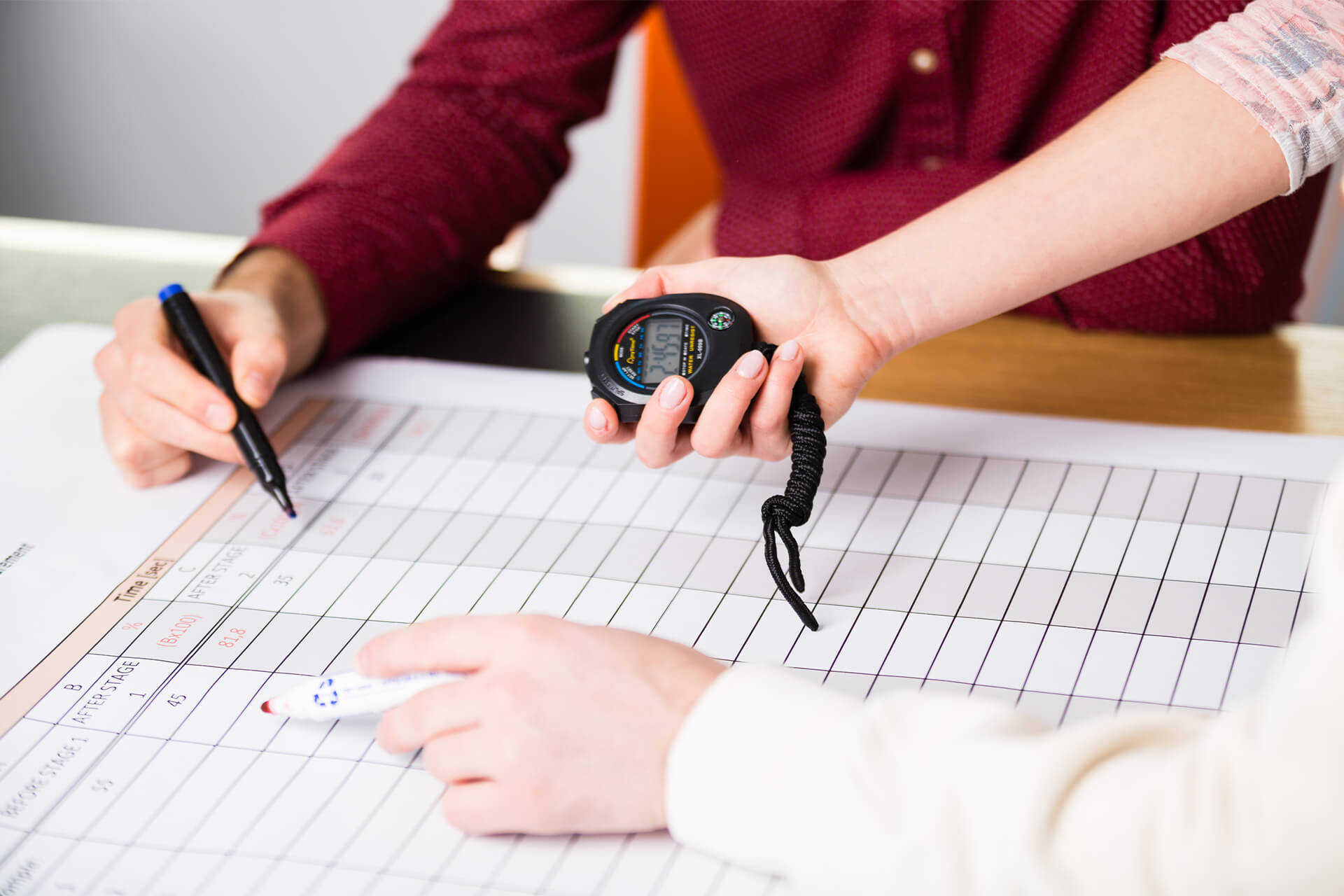
Employee productivity, defined as the ratio between planned working time and actual time spent on tasks under given conditions, can be effectively measured using work sampling studies.
LUQAM’s proprietary methodology is applicable in both office environments and production floors.
Work sampling is often complemented by job audits, which involve analyzing role descriptions, work instructions, competency matrices, and comparing them with observed reality.
These audits also evaluate communication flow, task delegation, and responsibility structures, offering a comprehensive picture of employee effectiveness.

Time Study
The aim of a time study is to determine the optimal time needed to complete a task under specific conditions, performed by employees with defined competencies.
This applies to both repetitive and non-repetitive activities.
Time studies are commonly used for establishing standardized work times.

Simulation-Based Optimization
In industrial projects requiring workforce optimization or headcount adjustment, simulation tools prove extremely effective.
Advanced simulators can calculate numerous production and financial KPIs, and visualize how changes impact critical indicators like Technical Manufacturing Cost (TMC), cycle time, WIP, productivity, and workload.

Workday Observation (Workday Photography)
Workday photography is primarily used to analyze individual productivity but can also help assess employee competencies and information flow efficiency.

Key Metrics
in Work Sampling
Studies
Work sampling focuses on analyzing three critical workload categories:



 01
01
How much time is spent on standard tasks?
02
Are employees performing activities relevant to their role?
03
Are there unplanned interruptions during the workday?
04
Are employees solely engaged in work-related duties?
05
What factors cause employees to lose focus on priority tasks?
Example of
a Workload Simulation
A simulation engine powered by advanced algorithms enables calculations that would be difficult or impossible manually. Once built, simulations can be reused and updated for future scenario testing.
This helps identify optimal solutions and supports data-driven decision-making based on the combined insight of simulation architects and operational consultants.

contact form
Let’s talk about a custom
Workload Analysis for your organization!

Janusz Dziedzic


newsletter
Join our newsletter
 HOW WE CREATE VALUE
 HOW WE GROW BUSINESSES
HOW WE DEVELOP TEAMS

LUQAM Sp. z o.o. Sp.k.
Kamieńskiego 47
30-644 Kraków
POLAND
KRS 0000442347
NIP 6793087067
REGON 122736324
LUQAM Sp. z o.o. Sp. k.
CEO: Łukasz Ekiert
Equity Capital: 250 000 PLN
